
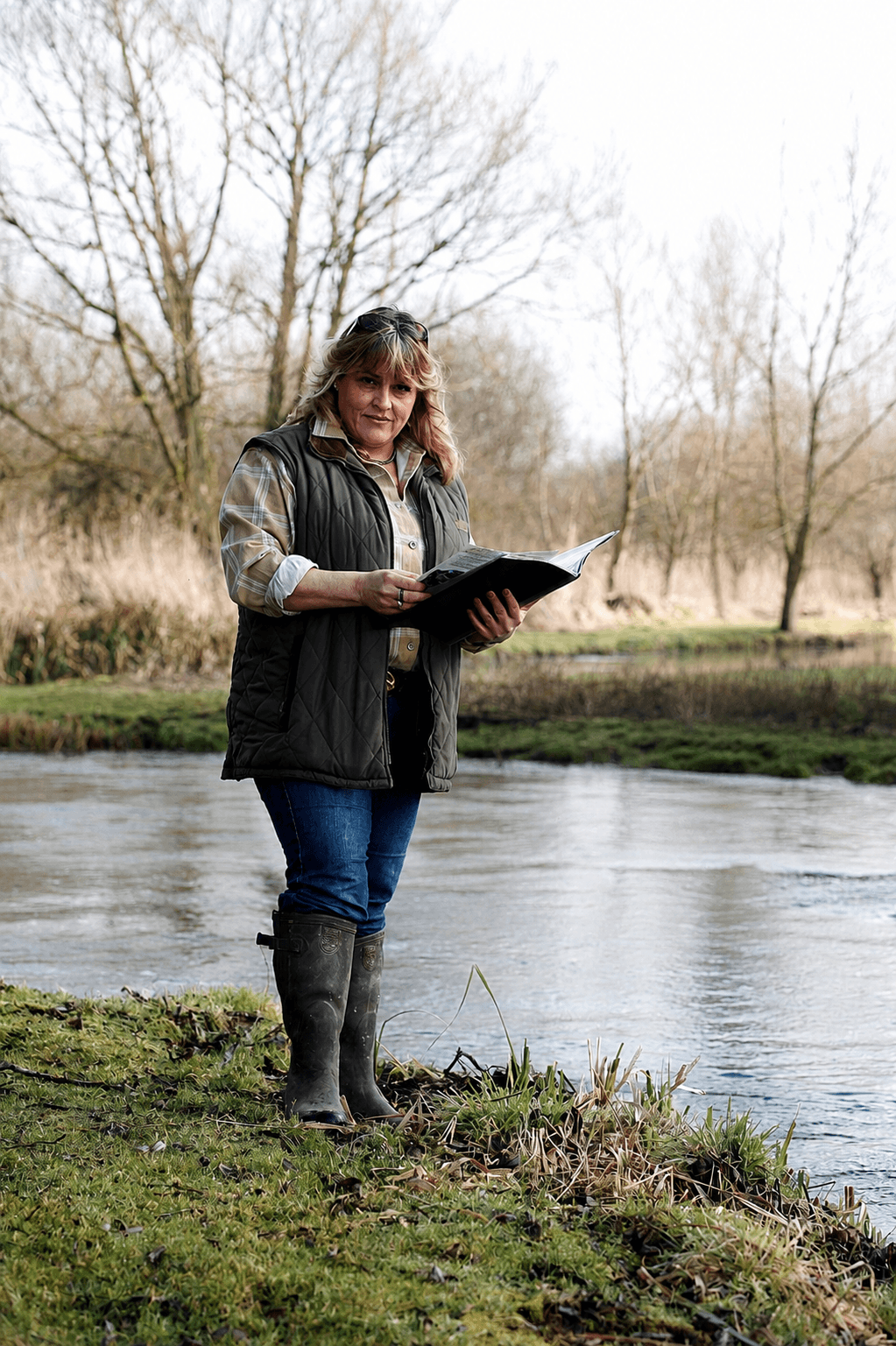
Few people have a closer connection to Lower Itchen Fishery than Lyndsey Farmiloe. Her family's association with the fishery began when her grandfather bought and created the Fishery in the 1950s, and she has spent more than 30 years helping to run one of Hampshire's most respected chalkstream fisheries. In this interview Lyndsey reflects on the fishery's rich heritage, the importance of conservation and the enduring appeal of fishing the River Itchen.
Can you tell us a little about yourself and your role at the fishery?
My grandfather, Granville Howard, started Lower Itchen Fishery in 1953 after
purchasing the river in five different lots. As a little girl I was not supposed to be
interested in fishing, as it was a male-dominated pastime, so I had to stay at
home and practise the piano instead! I only became involved with the fishery in
1987, when I stood in for my father at a directors’ meeting as he could not
attend due to ill health. I then became Company Secretary and, over the years,
took on more and more responsibilities, becoming a Director and Shareholder in
the early 1990s. I have run the fishery single-handed since 1994.
What does a typical day at the fishery look like for you?
There is never a typical day. It depends on the time of year and what needs to be
done. With the advent of email, you never know what is going to land in your
inbox and need your attention. My work involves all aspects of running a
company, from accounts, VAT returns, wages and pensions to advertising, but
the largest component is sorting out the bookings and talking to our rods. This
can be quite taxing in November, December and January, when I have to sort out
the season rods for the coming year. It can be like a massive jigsaw puzzle and
often involves me sitting in a darkened room with a towel over my head! After the
season rods have been allocated, it turns to day-rod enquiries and bookings, and
corporate quotations.
I try to go to the river as much as possible to see our rods, make sure everything
is running smoothly and discuss ongoing works with our river keeper, Clayton.
Then there are the corporate fishing events we hold. These can be for up to 18
people, and we provide everything that is needed. They are suitable for the
complete novice through to the experienced fly fisherman. We can provide a
ghillie service, tackle hire, suitable flies for the day and, of course, all the
catering requirements. These days can be long: I am often on site before 8am
and sometimes do not leave until 10.30 at night, but they are worth it when I
receive such lovely feedback from my clients and repeat business.
As well as the fishing, we own five of the mill buildings at Gaters Mill. These were
all totally derelict and some on the verge of collapse. I have project managed;
designed and in some cases prepared the technical drawings on a CAD system
for the conversion into high-end office spaces, whilst maintaining the character
with the old timber beams and exposed brickwork wherever possible as I feel it
important to keep as much of the original character and heritage within the
buildings.
There have been mill buildings on the site since Domesday and
hopefully by carrying out the renovation works they will be standing in hundreds
of years to come.
There is always something to keep me busy — so much so that I do not get any
time to fish myself!
What do you enjoy most about working on the River Itchen?
I love the river and its environs, with all the rich fauna and flora. The Itchen is a
very special place amid ever-expanding built-up areas, with all the pressures that
put on our fragile chalk streams.
It is both a privilege and a responsibility to be a custodian of the river for future
generations. It is a delicate balance – meeting demand for season and day rods,
which often outstrips availability, while preserving the river, the fish and the
surrounding environment for those who simply want to get away from it all.
I love just being beside the river and chatting to my fishermen, many of whom
come back year after year and with whom I have built up a great rapport and
unique friendships.
What makes the River Itchen such a special place to fish and to visit?
The Itchen is truly magical and makes me think of The Wind in the Willows and
Winnie-the-Pooh.
The Hampshire chalk streams, such as the River Itchen, are very rare, with only
200 in the world and 85% of those are in England. Chalk streams are
characteristically gin-clear, with a fairly constant temperature, and are very rich
in minerals where rainwater has permeated through chalk over 6-12 months. It is
this mineral-rich water that provides such unique conditions for the abundant
insect life on which the fish depend.
We are so lucky to have so much diversity on our 3 ½ mile stretch with brown
trout, salmon, sea trout, grayling and coarse fish in the winter months including
chub, bream, dace, carp and barbel.
Our salmon catches are still impressive compared to other southern
chalkstreams but any fish caught must be released to aid the conservation of
salmon.
We have fishermen who come from all over the world to fish this iconic river.
What happens behind the scenes to keep the fishery and river in such great condition?
It takes a lot to keep on top of the fishery for our river keepers. The summer
months involve cutting the fringe on the river edge, cutting the grass along the
entire 3 ½ mile length of the fishery, and cutting the in-river weed at times set by
the Test & Itchen Association. The weed cut can be a very labour-intensive
process, with Clayton physically wading in the river with a pole scythe to cut
selected weeds such as ranunculus, in traditional bar-and-line patterns, or in
such a way as to give clear areas of gravel while maintaining cover for the fish.
The biggest challenge with the weed cut is knowing how much to cut. If too much
is cut and it is followed by hot weather with no rain, the river levels can plummet.
Likewise, if not enough is cut and it is followed by weeks of torrential rain, the
river levels can overtop the banks.
The main maintenance is carried out from October to April and involves removing
watercress, cutting all the fringe, rebuilding and repairing bridges, walkways and
huts, keeping the gravel track repaired — which needs to be done every year
before the main spring season starts — and a great deal of tree work along the
entire length of the river.
What do visitors and anglers enjoy most about spending time here?
Apart from the quality fishing that the River Itchen provides, I would like to think
that we offer a friendly and helpful service to our fishermen. This is evidenced by
the number of rods who return year after year.
The river offers a place to unwind and relax from the stresses of modern life.
Many of our rods bring a lovely picnic to share with their fellow guests and while
away the hottest part of the day in summer. There are also facilities at the main
fishing cabin for those who would like to BBQ.
For someone who has never tried fly fishing before, what would you say to encourage them to give it a go?
It is a great sport and suitable for all ages and abilities. When fishing, people
often say that they totally switch off from the pressures of modern living, and
being in beautiful countryside with such rich and diverse wildlife all adds to a
wonderful experience.
I feel it is so important to encourage young people to take up the sport. It is so
much healthier than staying indoors playing computer games.
What do you love most about each season on the river?
Spring is, predictably, the best season. After the long, cold and wet winter
months, everything bursts into leaf; then you hear the first cuckoo and see the
first mayflies hatching.
Summer brings, especially lately, hot days, and some of our rods find a quiet,
shady spot on the riverbank and wait until the evening rise, when it is cooler and
the fish can go mad for the fly life.
Autumn can be a beautiful month, with misty mornings and autumn foliage, and
winter is the time when we are busy with our coarse fishermen, who brave the
elements to catch a prize grayling, barbel or chub.
What wildlife do you most enjoy seeing on the river?
All the wildlife is amazing to see, but for me it is probably the sound of a
kingfisher as it dashes past in a blaze of blue and orange. Typically, I never have a
camera on me when they appear. The appearance of the kingfisher is second
only to the sight of the mayflies as they fill the skies and dance on a warm May or
June evening — a truly amazing sight and one I always feel privileged to witness.